


Slat chain conveyor
A slat chain conveyor is a type of conveyor system that uses slats (metal, plastic, or wood panels) attached to a chain drive for moving materials. Unlike belt conveyors, the slats form a continuous surface that can carry products of various shapes and sizes, making it ideal for heavy-duty and irregular-shaped loads.
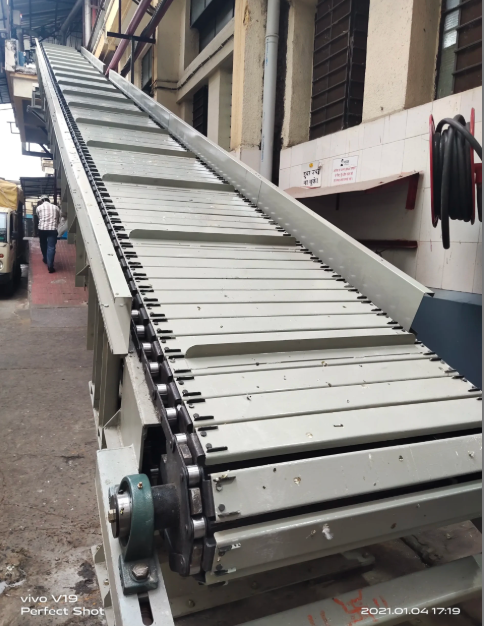
🔹 Key Features
Slats – Rigid panels attached to roller chains (can be steel, stainless steel, plastic, or wood).
Chain Drive – Motor-driven chains move the slats forward.
Durability – Heavy-duty construction for long service life.
Versatility – Can be made straight, inclined, or curved.
Customizable Surface – Slats can be smooth, textured, or fitted with fixtures for specific products.
🔹 Applications
Automotive industry – Engines, gearboxes, car parts.
Food and beverage – Bottles, cans, packaged goods (with stainless steel slats).
Manufacturing – Machined components, tools, castings.
Airports – Baggage handling systems.
Assembly lines – When fixtures or jigs are needed for precise movement.
🔹 Advantages
Handles heavy loads and irregular shapes.
Provides a stable, flat conveying surface.
Long-lasting and durable for industrial use.
Can operate in harsh environments (heat, oil, chemicals).
Easy to integrate with robotic or manual assembly systems.
🔹 Limitations
Heavier and more expensive than belt conveyors.
Requires regular maintenance (chains, lubrication).
Noisy compared to belt systems.
Less flexible in layout than modular plastic belts.
✅ In short:
A slat chain conveyor is best when you need a rigid, strong, and flat conveying surface to handle heavy, awkward, or hot materials in industrial, automotive, or food processing environments.
Would you like me to also prepare a diagram/photo-style illustration of a slat chain conveyor (once your image generation resets) so you can visualize it like the others?