


Roller chain conveyor
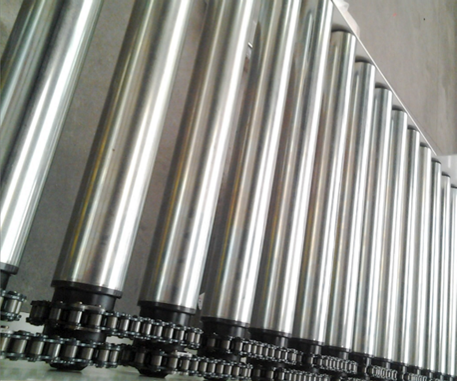
A roller chain conveyor is a type of conveyor system that uses chains (often with rollers attached) to move products directly or to drive carrying elements like slats, pallets, or fixtures. It is designed for heavy-duty applications and is widely used in manufacturing and industrial environments.
🔹 Key Features
Chain Drive – Uses one or more strands of heavy roller chains as the conveying medium.
Load Capacity – Can handle very heavy loads (pallets, engines, machinery parts).
Durability – Built with strong steel chains and reinforced frames.
Drive System – Motor powers sprockets that pull the chain.
Flexibility – Can be designed as straight runs, curves, or integrated with transfer systems.
🔹 Applications
Automotive industry (engines, transmissions, car bodies).
Heavy manufacturing (steel, foundry, metal parts).
Pallet handling in warehouses and factories.
Assembly lines requiring precise positioning of large products.
Paint shops and ovens (heat-resistant chain conveyors).
🔹 Advantages
Extremely durable and reliable for heavy-duty use.
Can move bulky, uneven, or very heavy items.
Handles continuous or stop/start operations well.
Customizable with attachments (slats, fixtures, jigs).
🔹 Limitations
Higher cost compared to belt or roller conveyors.
Requires regular lubrication and chain maintenance.
Noisy operation compared to belt conveyors.
Heavier, less flexible, and not ideal for light goods.
✅ In short:
A roller chain conveyor is the go-to system when you need to transport heavy or bulky materials reliably in industrial and manufacturing environments.
Would you like me to also create a side-by-side comparison of roller chain conveyors vs. roller conveyors (gravity & powered) so you can easily see their differences?